Posts

Showing posts with the label software

Software Development Agreements

Image
Fibre Optic Cables Author BigRiz   Licence CC BY-SA 3.0   Source Wikimedia Jane Lambert The key to a successful software development contract is a comprehensive and accurate technical specification that is agreed upon and understood by both the customer and the supplier.  It is important not to confuse a technical specification with a functional specification.   The functional specification will set out the functions and facilities that the software should have, but not state how it is to be developed.   Those details will be contained in the technical specification.    The customer should satisfy himself or herself that the technical specification implements the functional specification.   If he or she lacks the skill and knowledge to do that, he or she may wish to appoint a consultant to help. Acceptance Tests As the bargain is that the supplier will deliver the specified software in return for a fee, a clause setting out the ac...

Copyright - Edozo Ltd v Valos (UK) Ltd,

Image
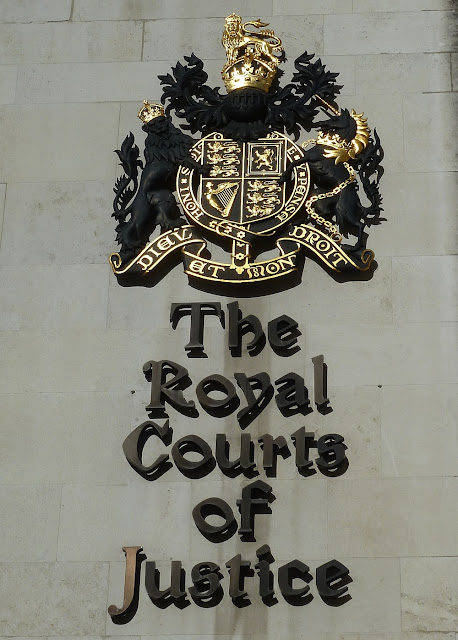
The Rolls Building , L ocation of the Intellectual Property Enterprise Court Author Muhammad Karns, Judicial Office X feed Licence CC BY-SA 4.0 Source Wikimedia Commons   Jane Lambert Intellectual Property Enterprise Court (HH Judge Hacon)  Edozo Ltd v Valos (UK) Ltd [2026] EWHC 93 (IPEC) (21 Jan 2026) This was an application by the claimant to strike out parts of the defendant's defence and counterclaim. The claimant had brought proceedings for a declaration of non-infringement of copyright, while the defendant counterclaimed for relief from infringement.     The claimant's application came before His Honour Judge Hacon on 15 Jan 2026.  By para [61] of his judgment in  Edozo Ltd v Valos (UK) Ltd [2026] EWHC 93 (IPEC) (21 Jan 2026), His Honour acceded to the application. The Parties The claimant was Edozo Ltd ( "Edozo" ) and the defendant was Valos (UK) Ltd . (" Valos ").  The judge described Edozo and Valos as "competitors in a market which...

Copyright - PQ Systems Europe Ltd. v Aughton

Image
Author Rob Farrow   Licence CC BY-SA 2.0 Deed   Source Wikimedia Commons Jane Lambert Business and Property Courts, Intellectual Property (Chancery) Mr Justice Zacaroli PG Systems Europe Ltd. and another v Aughton and another   [2023] EWHC 581 (22 March 2023) This was an action for copyright infringement and breach of confidence. It was brought by a software house against its former director and programmer. The claimants were a US company called Productivity-Quality Systems, Inc. ("PQS") and an English company called PQ Systems Europe Ltd. ("PQE").  The transcript refers to them collectively as "PQ".  PQE was not a subsidiary of PQS but it was founded, owned and run by the same person. When that founder died both companies passed into the hands of his successor.    The first defendant, Jeff Aughton ("Mr Aughton"), worked for PQE from 1989 to 2015  On leaving that company, Mr Aughton developed software packages that were similar to PQE's....

Software Patents: Adobe Systems Incorporated's Application

Image
Intellectual Property Office Crown copyright: all rights reserved, reproduced with kind permission of the  IPO Jane Lambert Intellectual Property Office (Mrs C L Davies) Re Adobe Systems Inc.'s Application   O/549/19 19 Sept 2019 This was an appeal by Adobe Systems Incorporated against the examiner's refusal to allow its application for a patent  for a method and system for recommending software actions to create an image and recommending images to demonstrate the effects of software actions to proceed to grant. The examiner objected to the application on the grounds that it was for a program for a computer and a mathematical method within the meaning of s.1 (2) (a) and (c) of the Patents Act 1977. That subsection declares that mathematical methods and programs for computers among other things are not inventions for the purposes of the Act but that declaration is subject to the proviso that it "shall prevent anything from being treated as a...

An Escrow Case at Last - Filmflex Movies Ltd v Piksel Ltd

Image
In my early years at the Bar I did a lot of work for John Morris who was in-house legal advisor to the NCC (National Computing Centre).  The NCC had been established in 1966 as an autonomous not-for-profit organization, to be the "voice of the computer user",  encourage the use of computers in the UK and  offer education and training in computers. John spotted an opportunity for his company. He saw a need for source code escrow and persuaded his employers to offer one of the first escrow services in the UK. Escrow is an arrangement by which a software house or software maintenance contractor deposits the latest version of a computer program in human readable form known as "the source code" to a trusted third party such as the NCC ("the escrow agent") with instructions to release the source code to the customer should the software house or maintenance contractor be unable or unwilling to maintain the program because of insolvency or some other ca...

Software Patents - Lantana v The Comptroller

Image
Lantana Ltd . ( "Lantana" ) is a California company that offers communication cable services, telephone systems and services and computer and data network services mainly to customers in Southern California . One of the company's employees invented a "method, systems, and computer program products for retrieving a file of machine readable data" for which Lantana applied for patents in the USA and around the world under the Patent Co-operation Treaty. The Invention  The invention is described in the abstract of the application as follows: "A user, wishing to retrieve a file of machine-readable data from a remote machine-readable data storage device, transmits a first e-mail message from a local station to a remote station via a packet switched network. The first e-mail message includes a first machine-readable instruction and a first machine-readable retrieval criterion. The remote station receives the first e-mail message from the packet ...

Patentability of Computer Programs: Halliburton Energy and Protecting Kids

It is some years since I last discussed software patents ( "Software Patents: January Patents Ltd.'s Application" , 16 Jan 2009, "Software Patents: New Guidance from the IPO" , 29 Dec 2008 and "Patents: Software Protection after Symbian and Bilski " 11 Nov 2008) and Judge Birss QC's decision in Re Halliburton Energy Services Inc [2011] EWHC 2508 (Pat) (5 Oct 2011) and Mr. Justice Floyd's in Re Protecting Kids the World Over (PKTWO) Ltd [2011] EWHC 2720 (Pat) (26 Oct 2011) justify a return to the topic. The Statutory Exclusion Most people in intellectual property and many in information technology know that a rt 52 (2) of the European Patent Convention and s.1 (2) of the Patents Act 1977 exclude from patentability: (a) discoveries, scientific theories and mathematical methods; (b) aesthetic creations; (c) schemes, rules and methods for performing mental acts, playing games or doing business, and programs for computers; ...

Unitary Patents: Spain and Italy throw in their 2 cents

Image
Compared to Germany, France, the Netherlands and Switzerland we don't do very well in the European patent application stakes but there are two large European countries that do even worse than us, namely Spain and Italy. According to the European Patent Office there were 4,088 patent applications from Italy in 2010 and 1,436 from Spain compared to 27,354 from Germany, 9,530 from France, 6,742 from Switzerland, 5,957 from the Netherlands and 5,402 from the United Kingdom. Most people in the United Kingdom who have an opinion on the subject believe that a European patent for the whole European Union would be a very good thing. At page 25 of his report , Professor Hargreaves recommended that the UK "should attach the highest immediate priority to achieving a unified EU patent court and EU patent system, which promises significant economic benefits to UK business" which recommendation the government has accepted. While we may not be good Europeans in every respect we have...

Patents: Fisher Rosemount Systems Inc.'s Application

The first decision from the Comptroller for 2010 offers an interesting discussion on how to assess an invention's technical contribution when applying the Aerotel/Macrossan and Symbian guidelines. In Fisher Rosemount Systenms Inc. Application BL 0/003/10 12 Jan 2010 the applicant appealed against the examiner's report that the claims of the invention were excluded from patentability because they related to a computer program as such. The invention related to a process control system and in particular to a method of accessing process control data, viewing and modifying that data and using the modified data to update control programs within the system. The invention described a method by which the operator is able to develop and to add functionality to his or her own applications at any time without the need to rewrite or compile the control system software. The applicant claimed: "A system for accessing process control data, comprising: a pre-generated partial class th...